A library without Dewey

Phrontisterion, Mona's new library, opens this week: 30,000+ books, no Dewey, every one still findable.
Nic Whyte, Founding Principal
In 2011 we opened Mona, David Walsh's Museum of Old and New Art in Hobart, and we took the wall labels off the walls.
It sounds like a minor thing. It wasn't. Once the labels were gone, the building was free. Lighting could be designed for the art instead of the text beside it. Walls could be black, or rough, or pushed to whatever extreme the work wanted. A piece no longer had to sit next to a plaque, which meant it no longer had to sit where a plaque made sense. Art could be placed by story rather than by the old museum logic of date, geography and movement. Old next to new, painting next to object — because of what they said to each other. None of that information was lost. It moved onto The O, the handheld guide we built for Mona. The O finds you and presents the art around you with long-form essays, opinions, artist interviews, audio, video and more. The label had been quietly running the room. We removed it, and David got his room back.
The library didn't get the same treatment. Not then.
I remember being in the original Mona library with David in mid 2011, while he told me he'd stuffed it up. He'd rethought what a museum could be and then brought the books in and arranged them like every other library: shelves in the middle of the room, books sorted by Dewey. He'd freed the art and filed the books. In his words: "I really fucked up the original Mona library…"
Libraries are David's oldest love. Before the art, before the gambling that paid for the art, there was a small public library in Glenorchy, where most kids were allowed two books at a time and he was allowed six. He made an attempt to read every book he took home, and a serious attempt to take home every book in the library.
The chance to fix it came back through Anselm Kiefer. When David and architect Nonda Katsalidis were working through Kiefer's Elektra, the great inverted concrete amphitheatre, they kept circling the empty volume under and around the work. As David tells it: "And then we decided to fill up all the negative space, all the space that Kiefer hadn't used, with a library." Since then it’s expanded beyond that negative space, pushing out and down to hold a collection of over 30,000 books, maps and manuscripts. David called it Phrontisterion, after the 'thinkery' in Aristophanes' Clouds, the school of clever-clogs the play invents to send up the intellectual vanity of the day. Naming a library after a nearly 2,500-year-old joke about people taking themselves too seriously tells you something about David before you've opened a book.
In late 2022, David texted me the brief:
I want a system where we can move books arbitrarily, but still know where they are. Because the order of books on shelves and in stacks is fixed, librarians aren't curators. They should be. We can, at whim, move art around to say what we like to say with art. Today we emphasise colour, tomorrow connections with Dada, or medium, or country of origin. Why can't we do this with books? Because, if we move them around, we can't find them anymore.
That message began over three years of research and development.
The reason Dewey can't do this is structural. As David puts it: a book about Mars should be near a book about Mercury if we're talking planets. But if the book is also about Roman mythology, we'd be browsing mythology, and we'd not find what we were looking for. Dewey assumes a book is about one thing and belongs in one spot. Real collections, and real curiosity, don't work that way.
Dewey also encodes a fixed nineteenth-century worldview: Western, colonial, with Christianity at the centre. Even rebalanced, it forces a single hierarchy onto everything humans know.
David handed us the problem and, in the same brief, the answer. Don't tag the books. Photograph them. We'd already learnt the trick building The O: if we know where a visitor is standing, we can show them the art nearby and let them pick the piece in front of them. Turn that around for the library. If we know what a book's cover and spine look like, we can photograph a shelf and work out where every book on it is. No chips, no tags, no barcodes on the spines. A camera, and a system that learns the collection.
So that's what we built. Today a suite of systems goes live that does one deceptively simple thing: it lets David and the librarians put any book anywhere, by any logic they like, and still find it. Books pulled together because they're in the current exhibition. David's childhood books. Books placed alongside the objects and artworks they reflect. Artists who've shown at Mona. The science fiction that raised David. Arrangements that hold for a week, or a decade, or until someone changes their mind. The librarians are curators now, which is the whole point.
There was another problem to solve before any of that, the one every library has and few mention: cataloguing. We spoke to a number of libraries and heard the same thing each time. Cataloguing is slow, painstaking work. A collection that arrives by bequest, donation or inheritance can wait months or years to be entered into the library system, and until it is, it may as well not exist. So we built a faster way. Photograph a shelf of uncatalogued books and the system identifies them, draws their details from external catalogues and creates the records. Work that took years now takes weeks.
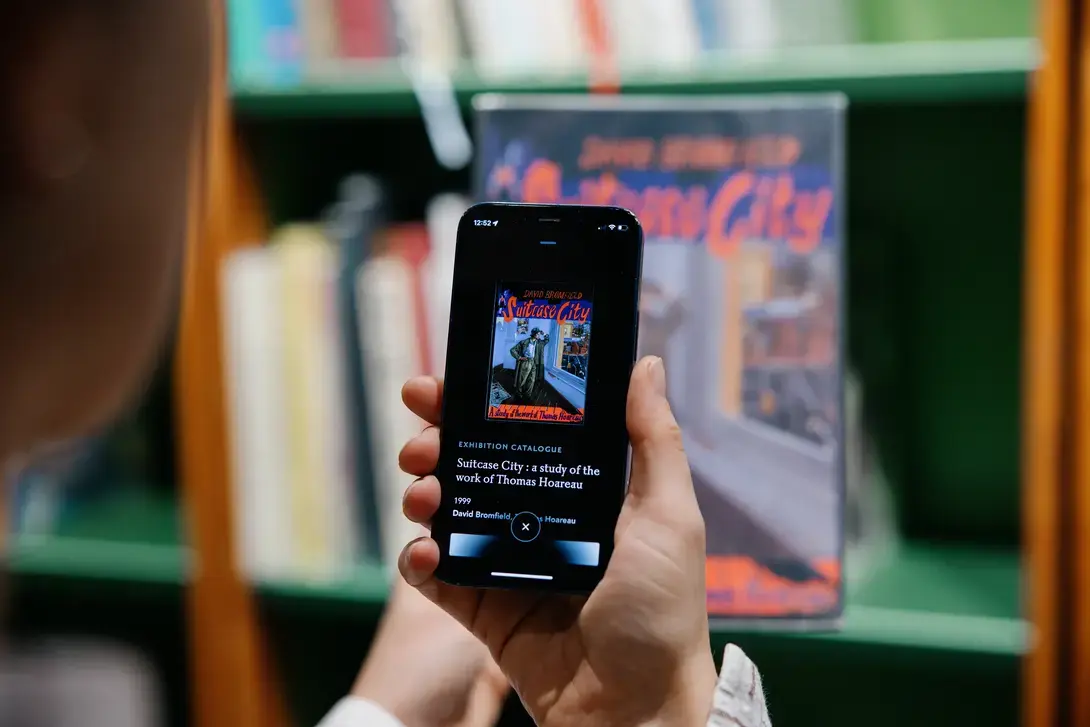
The O has been extended to support the new library, a big departure from its role in the museum. Here it needs to guide visitors to a specific book on a specific shelf. It draws on Pladia's wayfinding, spatial awareness and an upgraded version of Mona's indoor positioning to do it. Point your phone camera at a book and it becomes a window. Here's what this book connects to, here's what sits near it in ideas even when it's nowhere near it on the shelf. Search for a title, follow a theme, or just wander and let the nearby arrangements find you.
The system supporting the new library gets richer the more it's used.

Upon entry into Phrontisterion from the museum, there are twenty interactive bookcases along the west wall. They work like a returns shelf: leave a book on display and it's captured, identified and projection-mapped automatically, its relationships drawn live across the hundreds of books spread over the twenty cases. Stand a book face-out and you watch it happen, the system tracing its connections to the spines around it. Relationships spread beyond the confines of Dewey, the clearest proof that a theme here isn't a location. An idea can run the length of the library.

For the rare and the fragile, there's The Dial. It's furniture, not a screen on a wall: a digital reading desk with a weighted brass dial as its only interface, letting you turn through a book page by page at full scale with real tactility, as close to the object as you can get without your fingerprints on it. All twelve volumes of Johannes Blaeu's atlas sit in drawers beneath their case, shown together for the first time. Shakespeare's First Folio has its own station, showing any of the 36 plays. So does Picasso's sketchbook, page after page. A shared station holds the rest: Ptolemy’s Geographia, Jean Dubuffet’s Labonfam abeber par inbo nom, John Watt Beattie’s Hobart, with more added as they’re digitised.
Wall labels are dead. Dewey is dead. Long live the book!
None of this replaces the book. The books are the primary interface. We used a lot of technology to keep a room full of physical objects at the centre of the experience, not to dissolve it into a screen. The machine's job is to make the collection findable and surprising. The wandering, the reading, the being changed by what you find: that part is still yours. Every book is a window into the broader collection, through an evolving series of thematics and relationships. This is a library that learns and changes with culture, with the idiosyncratic nature of David. And we think it's more relevant than ever.
Phrontisterion opens to the public at Mona, Sunday 21 June 2026.
The technology behind Phrontisterion was designed and developed by Art Processors. Built for Mona's collection but engineered so it can be applied to any library. Pladia, the platform behind The O, provides the spatial awareness and wayfinding layer. The wider system: rapid cataloguing, real-time location tracking and relational discovery, are commercially available and can be adapted to the needs of other galleries, museums and libraries.
If your institution has a collection it wants to make findable, we'd like to hear from you.
Briefs like this don't come along often. To our team at Art Processors: you've made something rare, and truly magical. Thank you.